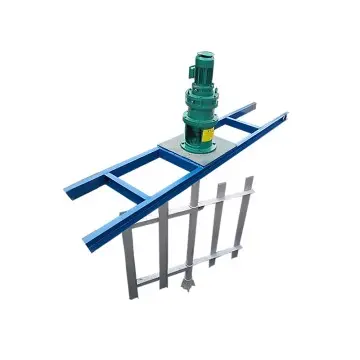

Monorail Sludge Scraper
Product Structure
1.Drive Unit
Two-stage reduction via motor-connecting rod cycloid reducer, driving the
endless chain through an overloaded shear ring chain wheel set. The motor
reverses direction to enable reciprocating motion. All components are protected by a full protective cover.
2.Scraper Trolley Unit
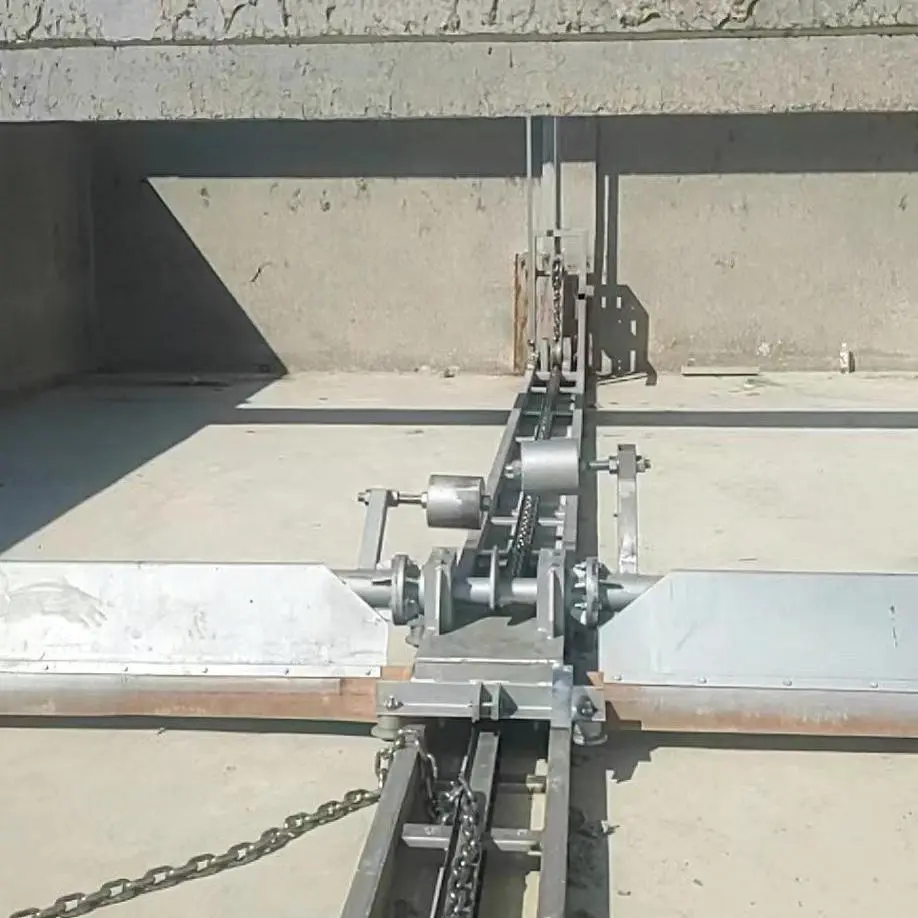
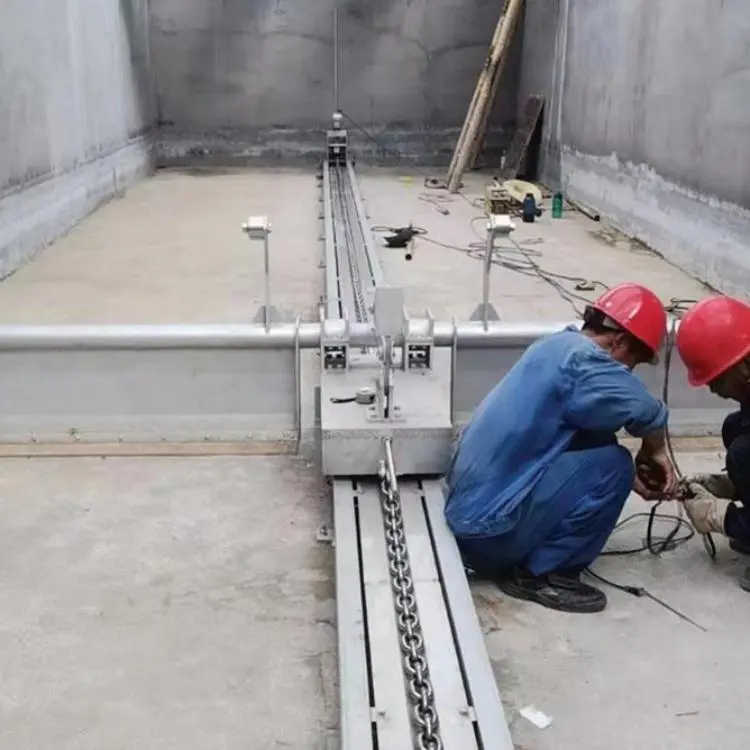
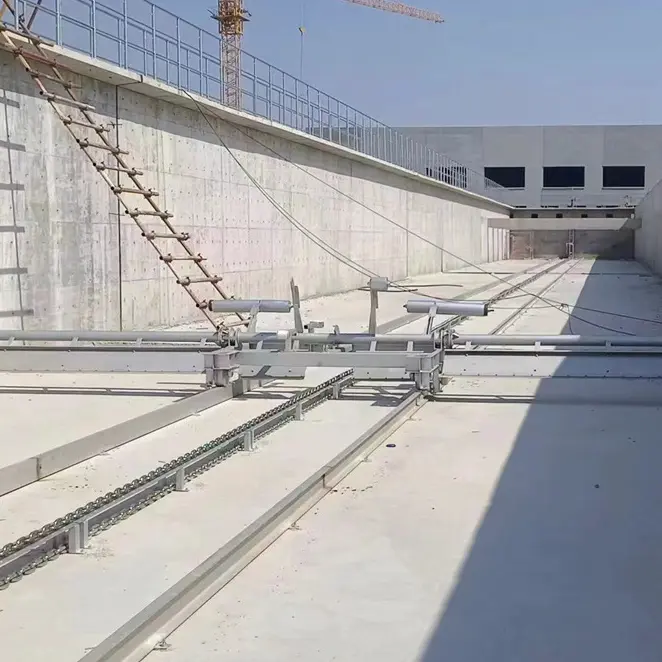
Composed of trolley frame, axle, guide wheels, scraper blades, and blade turnover mechanism. Both ends of the
trolley are fitted with endless chain shackles to form a closed loop, enabling reciprocating scraping and turnover on
the track.
Long tanks use multi-trolley configurations with coupling rods to ensure synchronized movement. Scraper blades
are paired and mounted on the output shafts of the trolley’s turnover mechanism. Rubber plates at the blade tips
maintain consistent or slight flexible contact with the tank floor/wall.
The blades remain vertical during forward scraping and rotate 90° flat during return travel.
3.Track Unit
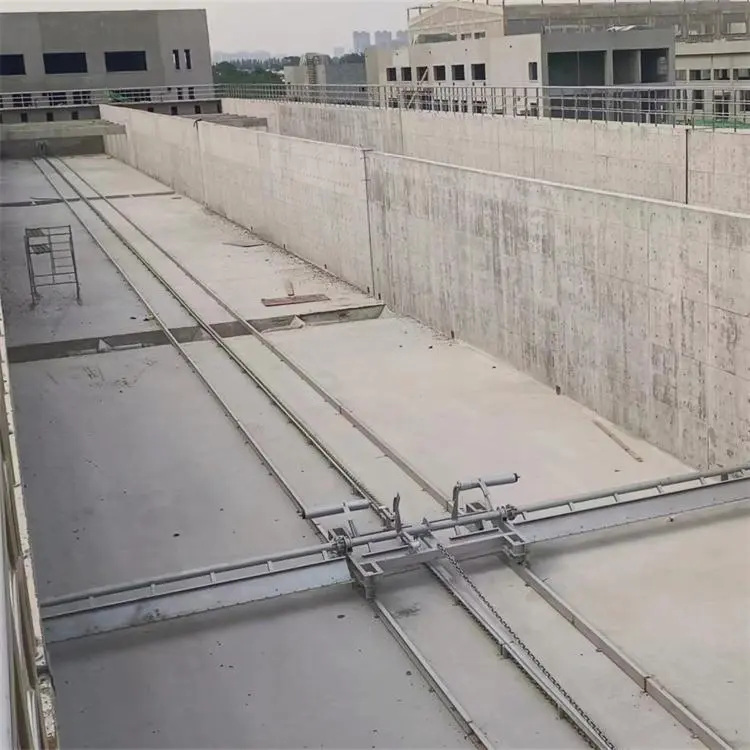
Consists of head track, tail track (and middle track for long tanks), installed along the tank centerline to provide a
flat, reliable running path. Chain turning devices are mounted at both ends of the track.
4.Electrical Control Unit
Supports both on-site and remote control. The scraper can perform two operating modes: forward scraping and
return. After receiving a stop signal, it stops accurately and reverses direction. Each cycle includes adjustable delayed startup and stop time (1~999s optional).
Reciprocating signals are generated by the tank-end signal heads, connected rods, pull rods, and moving rods,
triggering travel switches to convert mechanical signals into electrical commands. Double-limit travel switches and
proximity switches ensure reliable direction control.
Complete electrical protection: motor overload protection, mechanical limit stop alarm, remote start/stop, protection alarm, and blade position indication.
Product Application
The DG-type monorail underwater sludge scraper is designed for rectangular horizontal-flow sedimentation tanks,
inclined plate tanks, sludge thickening tanks, and floatation tanks in large waterworks and wastewater treatment
plants.
Simple structure with reliable mechanical operation and complete electrical control protection.
Easy installation, high scraping efficiency and adaptability, suitable for automatic operation.
Equipped with an endless chain drive system to pull the scraper trolley back and forth, collecting sludge from the
outlet zone to the inlet zone’s hopper for discharge, with high underflow concentration and excellent performance.
Product Features
-Modular Design
Flexible combination of single or multiple scraper trolleys to meet various process requirements. Core components: drive unit, scraper trolley, track unit, and control unit. Configurations include single-tank single-trolley,
single-tank multi-trolley, and dual-tank linked trolleys.
-Stable & Durable Structure
Roller-type trolley design with proven structural reliability. Operates stably under heavy or unbalanced loads (up
to 200kg reference). Endless chain provides strong traction, with blade width up to 9m and height 400~500mm for
increased sludge handling capacity.
-Low Maintenance
Trolley components can be easily disassembled and lifted for maintenance. Complete overload shutdown protection and blade status indicators minimize maintenance costs and extend service life.
-High-Concentration Sludge Discharge
Sludge collected in the hopper has high solid concentration, eliminating the need for secondary treatment before
dewatering, reducing process costs and footprint.
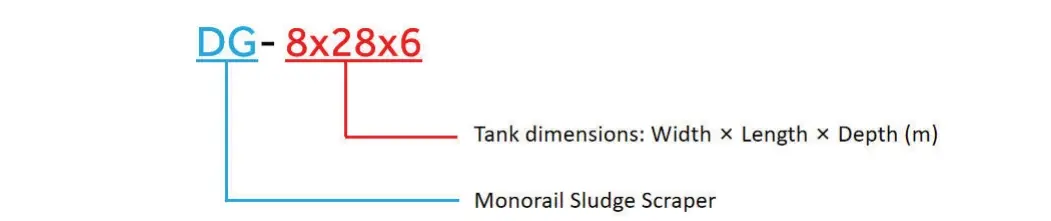
Product Naming Convention
Model Specification Table
|
Model |
Configuration |
Tank Area |
Power (kW) |
|
DG |
Single scraper trolley |
<200 m2 |
0.55 |
|
DG |
Single scraper trolley |
200~400 m2 |
0.75 |
|
DG |
Dual scraper trolley |
200~400 m2 |
1.1 |
|
DG |
Dual scraper trolley |
400~800 m2 |
1.1 |