
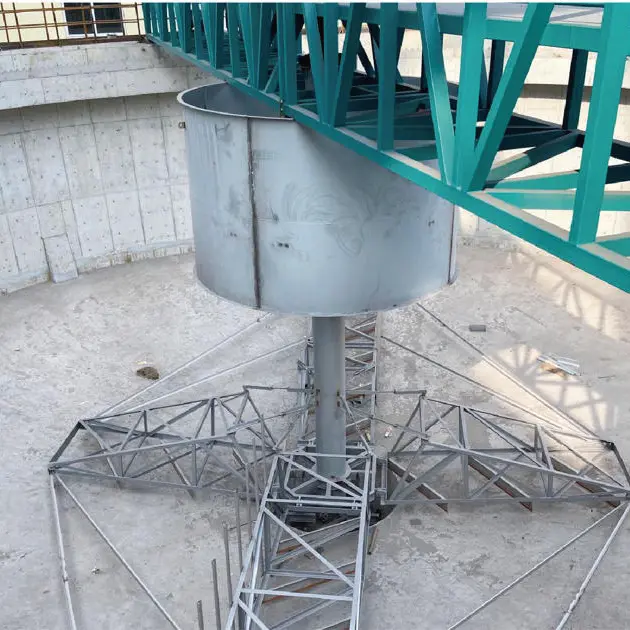
Thickener
Also named thickening tank, it is widely used in cyanide leaching process of
mineral processing plants for slurry thickening, washing and bufering. By
drive type, it is divided into central drive type and peripheral traction drive
type, specifed by inner tank diameter (central drive) or annular track diame-
ter (peripheral drive).
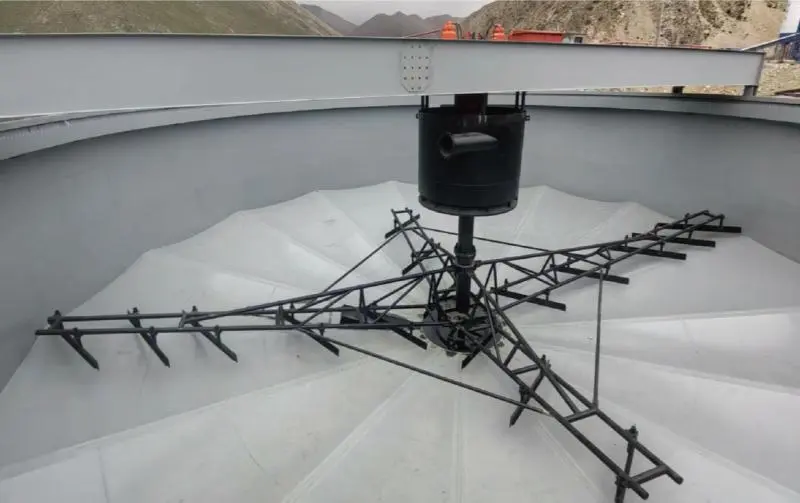
Central-drive thickener consists of circular tank, rake assembly and drive
unit. The tank bottom is a gentle cone with bottom slope 6°~12°, mostly concrete structure or steel plate fabrica-
tion. An overfow launder is arranged along inner tank wall for clear water overfow. The vertical central shaft at tank center connects with rake frame; rake frame is composed of rake arm, scraper and tension bracing, two groups of
radial rake arms arranged crosswise. Rake blades are fxed on arms at ~30° inclination to push settled underfow
toward central discharge port; vertical shaft fts into worm lifter’s inner worm wheel for up-down foating displace-ment.
Working Principle
Slurry separates into overflow clear liquid and high-density underflow by gravity sedimentation to finish thickening.
-Free Settling: Low-concentration slurry, negligible inter-particle interference, particles sink only against water
resistance.
-Hindered Settling: High-concentration slurry, obvious collision & mechanical friction between particles, slower
terminal settling velocity vs free settling.
Continuous thickener is divided into 4 functional zones: Clarification Zone, Hindered Settling Zone, Compression
Zone and Compaction Zone. Stable feed & underflow discharge keeps each zone height fixed under dynamic balance.
Practical recommended minimum height: Clarification Zone ≥0.2~0.3m, Hindered Settling Zone ≥0.3~0.5m.
Product Application
Extensively used for solid-liquid concentration & separation in metallurgy, mineral processing and chemical industries, with standard tank diameter: 3~100m, tank depth: 2~4m.
Four Development Stages of Thickener
1.Early thickener without flocculant: huge floor space & low thickening efficiency.
2.Thickener with primary flocculant dosing: smaller footprint and faster settling rate.
3.High-efficiency thickener: upgraded sedimentation principle, drastically reduced tank area on the basis of flocculant addition.
4.Deep-cone high-density thickener: smaller footprint + greatly improved underflow concentration to paste status.
Structure Introduction
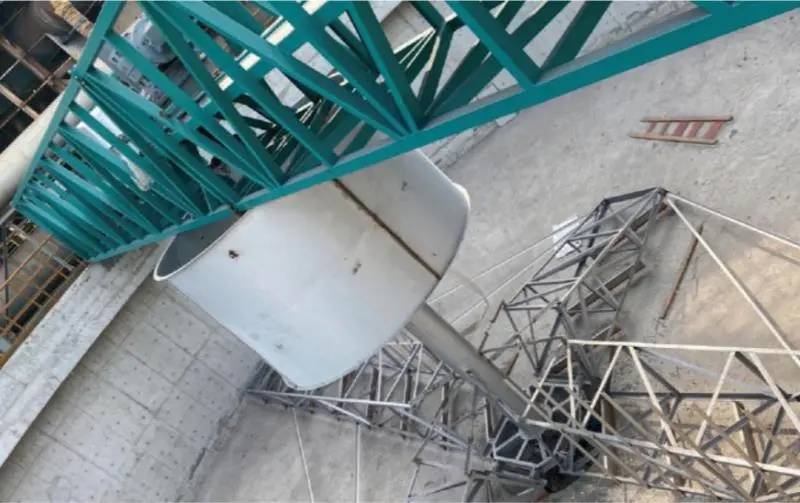
Standard thickener consists of thickening tank, bridge frame, drive unit, rake lifting device, feeding assembly, underflow discharging unit and safety signal protection device.
Product Classification by Drive Form
-Central Drive Type: Small tank diameter, generally ≤24m.
-Peripheral Trolley Traction Drive: Large & medium-size thickener, common diameter ~53m, max up to 100m.
-Peripheral Rack Drive: Rarely used at present, normally for tank diameter above 53m.
Features
Flocculant dosing increases particle aggregate size to accelerate settling velocity.
Inclined plate fitted to shorten settling distance and expand effective settling area.
Realize layered sedimentation including flocculation, filtration and compression to improve throughput capacity.
Equipped with automatic control system.
Core working principle: Add quantitative flocculant into feed slurry to aggregate fine mineral grains into large flocs
for accelerated sedimentation and improved thickening efficiency.