


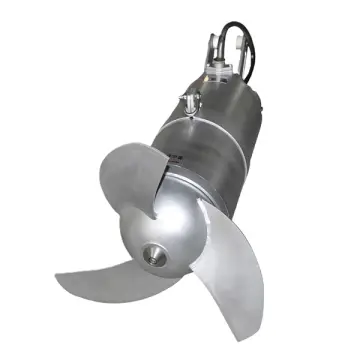
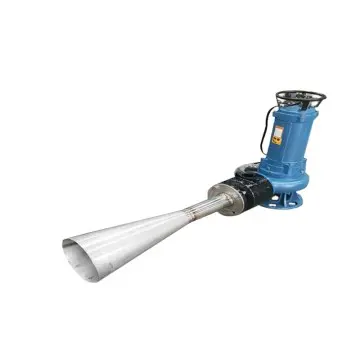
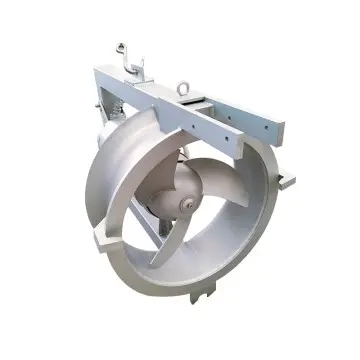
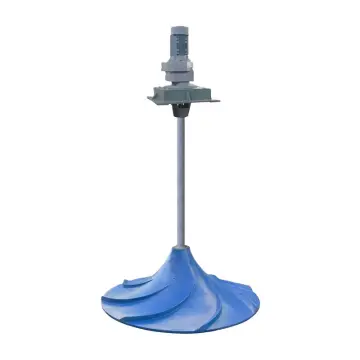
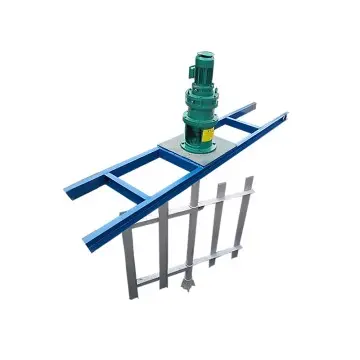
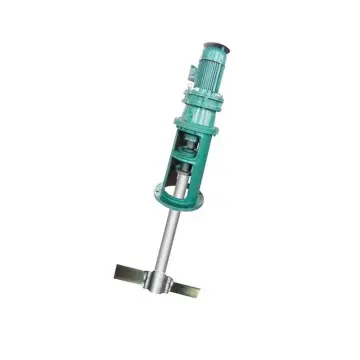


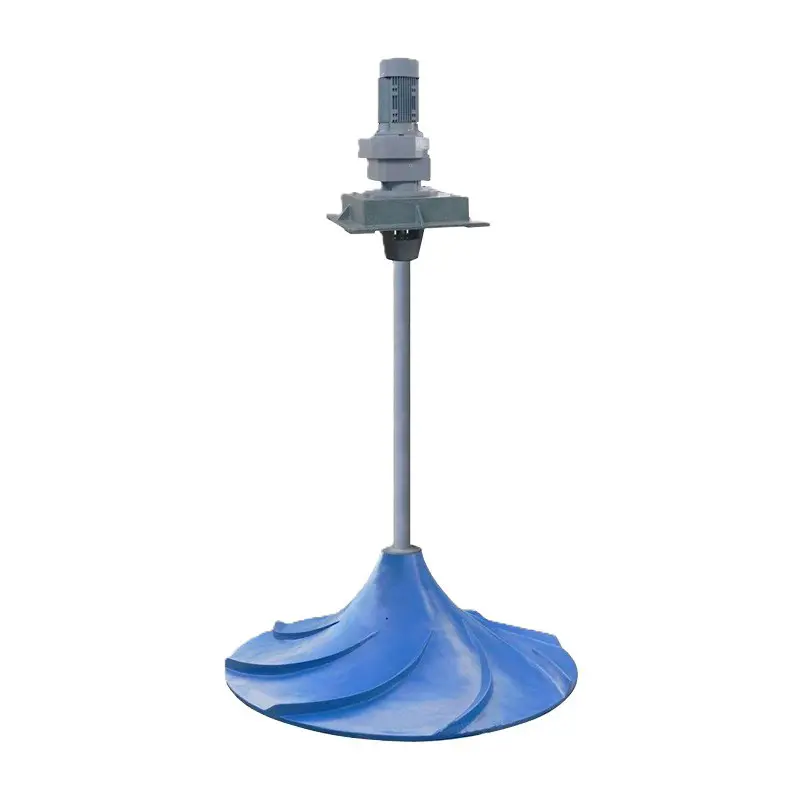
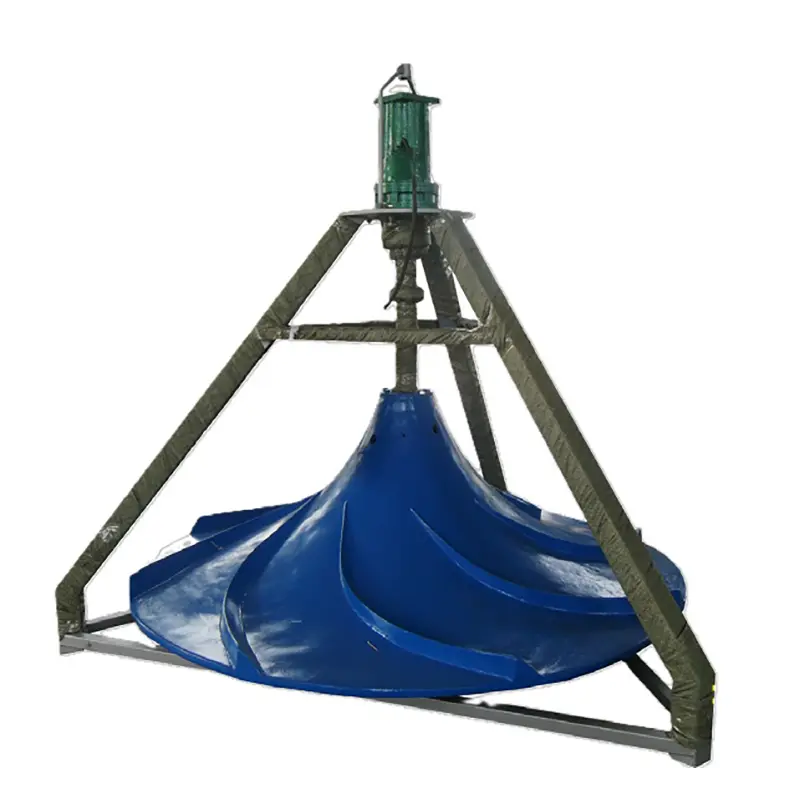
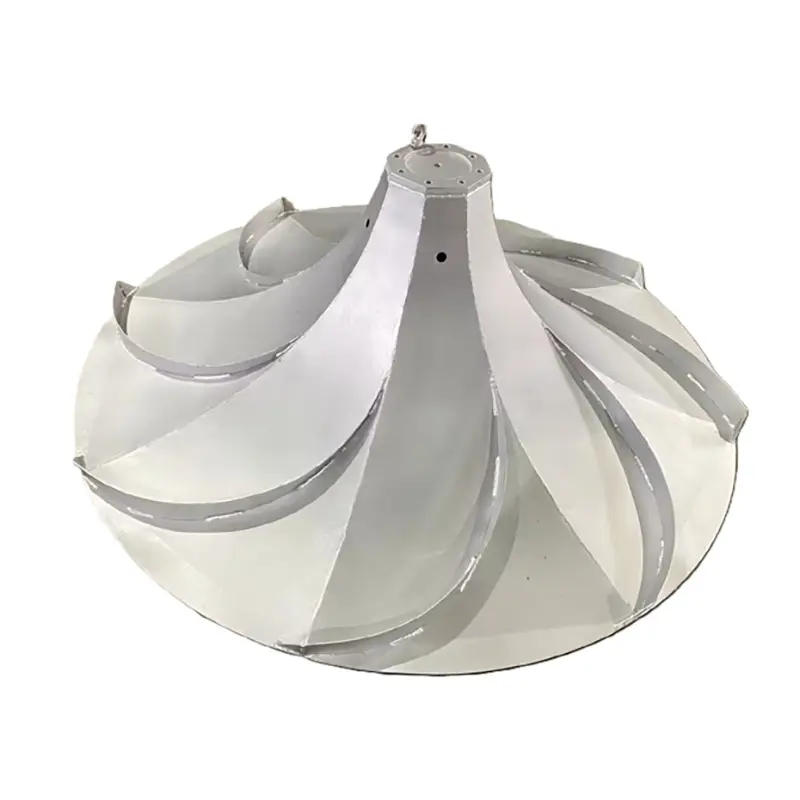
GSJ/QSJ-Hyperboloid Mixer
Features
The GSJ/QSJ hyperboloid mixer, as a high-efficiency mixing device, is suitable for mixing various low viscosity liquids, solids, and gases. It is suitable not only for circular and square tanks but also commonly used in modular arrangements within rectangular water tanks. The hyperboloid mixer overcomes the problems of dead zones and poor water-air mixing in aeration processes inherent in traditional paddle mixers.
1. It can be used in various applications involving the mixing of liquids with solids and gases, replacing existing mixing equipment to achieve three-dimensional, spiral mixing, resulting in more uniform mixing and improved efficiency.
2. The large specific surface area impeller requires less power, provides a large circulating water flow, and consumes less energy, saving 30%-50% more energy than traditional mixing methods.
3. The machine has a compact structure, reliable operation, and convenient installation and maintenance.
4. The impeller is made of reinforced fiber or steel, adaptable to different working conditions, and has a long service life.
Working Principle
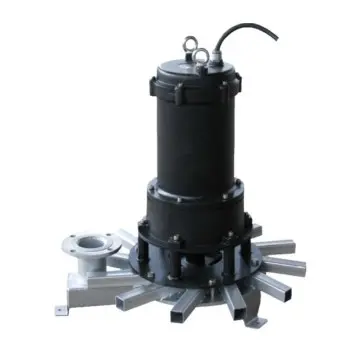
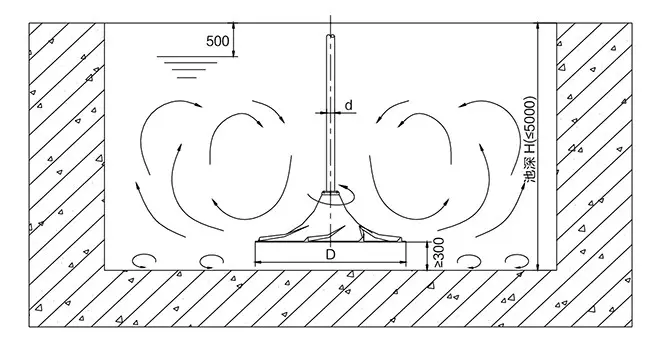
The GSJ/QSJ hyperboloid mixer’s impeller features a hyperboloid structure formed by rotating a hyperbola generatrix around the impeller’s axis, maximizing the integration of fluid characteristics with mechanical motion. The hyperbola’s equation is xy=b, and the surface is formed by rotating the curve along the y-axis. To accommodate water flow, water enters from the center of the impeller, reducing turbulence and ensuring uniform pressure on the impeller surface, thus maintaining overall balance during operation. Eight guide vanes on the hyperboloid surface utilize the potential energy gained from supplemental water intake due to the liquid’s own weight, combined with the centrifugal force generated by the impeller’s rotation, to create kinetic energy. Under the influence of gravity, the liquid undergoes tangential motion along the impeller’s circumference through the hyperboloid structure. Reflected by the tank walls, this creates a top-down circulating flow, resulting in cross-flow in both the axial and radial directions.
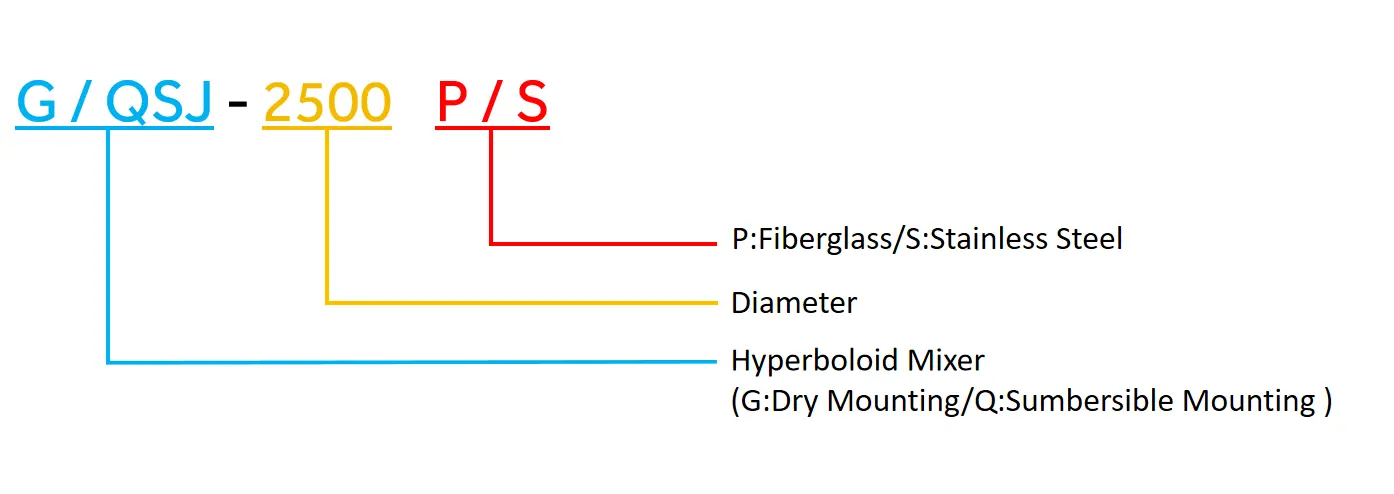
Product Naming Convention
Model Specification Table
| Model | Diameter mm | Rotational Speed r/min | Power kW | Service range (tank width m) | Weight kg | |
| Stainless Steel | Fiberglass | |||||
| G/QSJ500P/S | 500 | 40--250 | 0.75--1.5 | 1--3 | 320 | 300 |
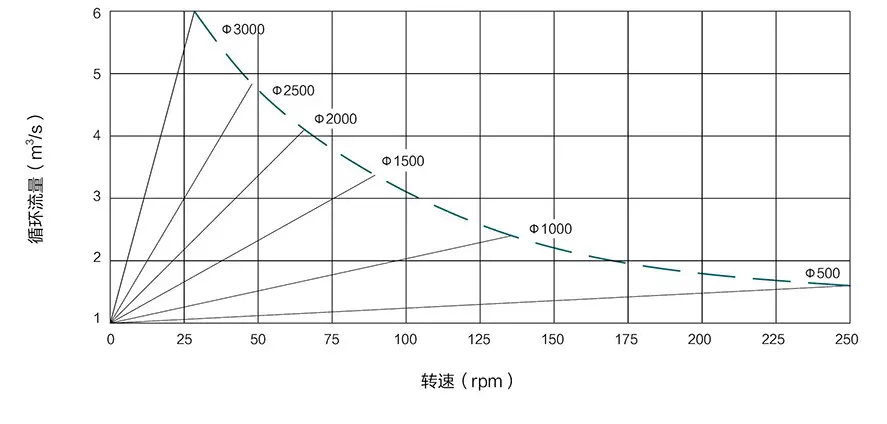
| G/QSJ1000P/S | 1000 | 30--80 | 1.1--2.2 | 2--5 | 700 | 500 |
| G/QSJ1500P/S | 1500 | 30--60 | 1.5--3 | 3--6 | 850 | 600 |
| G/QSJ2000P/S | 2000 | 20--42 | 2.2--4 | 6--14 | 1100 | 650 |
| G/QSJ2500P/S | 2500 | 20--40 | 3--5.5 | 10--18 | 1200 | 700 |
| G/QSJ3000P/S | 3000 | 20--30 | 4--7.5 | 12--22 | 1250 | 900 |
Installation Method
The installation of hyperboloid mixers can be divided into three types: dry installation, submersible installation, and float installation.
Submersible installation allows the mixer to be lifted directly into the designated location using a crane, relying on its own weight for positioning and cable securing. Installation is flexible and convenient, suitable for deep, stable, non-abrasive water bodies with a temperature below 40C° and a pH value between 6 and 9. It operates without noise or visual obstruction.
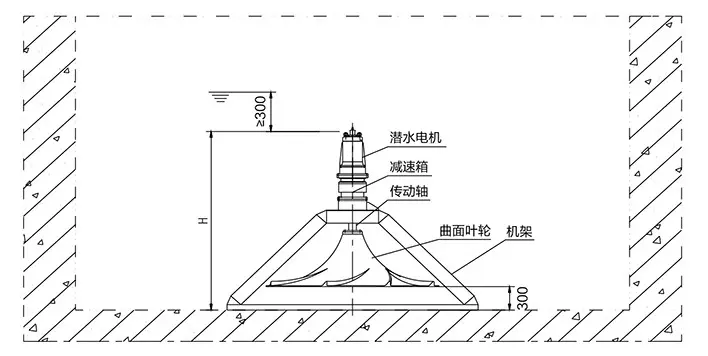
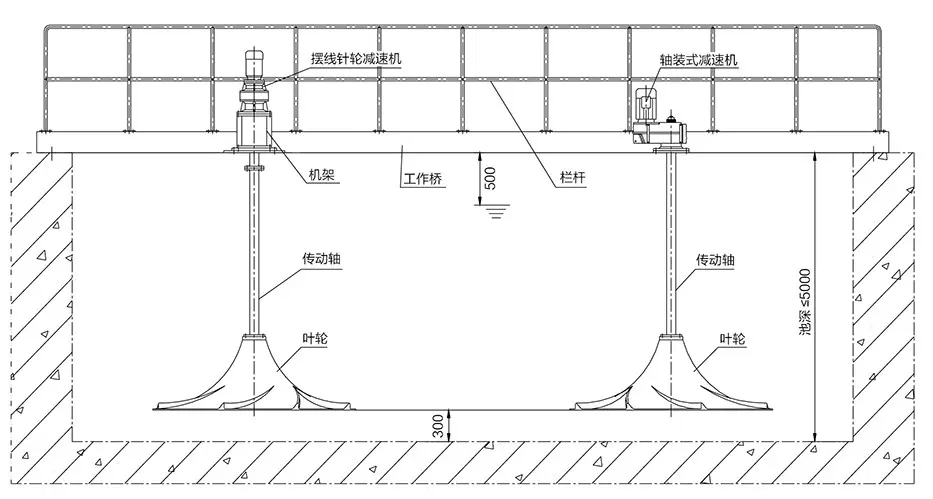
Dry installation involves fixing the drive unit to the working bridge, transmitting kinetic energy to the impeller components in the medium via a drive shaft. It is suitable for liquids with high solids content, high water temperature, and abrasive properties. Due to the impeller’s automatic alignment function, operation is smoother, and the reducer noise is less than 60 decibels.
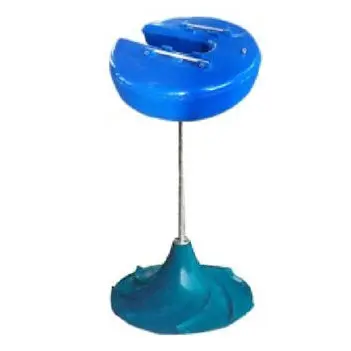
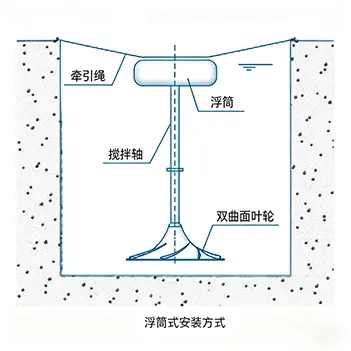
Float installation is the third installation mode for hyperboloid mixers, mainly suitable for places where there is no solid, flat pool bottom and it is inconvenient to install cable trays.
Model Selection and Application
The selection of GSJ/QSJ hyperboloid mixers is similar to that of other types of mixers. The selection of a hyperboloid mixer depends on parameters such as the type and volume of the tank, the depth of the liquid, the concentration of the medium, temperature, and pH. The selection of a hyperboloid mixer is mainly based on the effective service area of each unit. Following the principle that the ratio of tank length to tank width should not exceed two, a rectangular tank can be divided into several equal working units to determine the number of mixers. For water depths exceeding 5 meters or concentrations exceeding specified limits, increased power or higher mixer speeds should be considered during selection to ensure the desired mixing effect in large-volume and high-concentration media. Under normal operating conditions, dry installation is recommended. For applications requiring high noise levels or good visibility, submersible installation is recommended. Our company can assist users in selecting mixers for special environments.
Precautions
1. Before installation, a qualified electrician should inspect the motor and electrical components, and determine the rotation direction. The minimum working distance between the impeller and the bottom of the pool should be ≥300mm, and the pool bottom should be flat, firm, and free of construction debris.
2. If the equipment has not been running for an extended period, prevent silt buildup from clogging the impeller and damaging the motor upon restarting.
3. In enclosed pools, the inlet and outlet dimensions of the impeller must be considered.
4. Regardless of the installation method, ensure the underwater cable is securely fixed to prevent wear.
5. Carefully read the product installation and operation manual before use.