












What Size Aerator Do I Need for My Wastewater Treatment Plant?
Choosing the correct aerator size is one of the most critical engineering decisions in wastewater treatment plant (WWTP) design and operational optimization. Whether you are upgrading an existing municipal activated sludge system, managing high-strength industrial effluent, or maintaining a biological lagoon, aeration accounts for 40% to 60% of total electrical energy consumption.
Installing an undersized aerator causes low dissolved oxygen (DO) levels, anaerobic dead zones, incomplete biological oxidation, and severe compliance violations. Conversely, an oversized system leads to high power bills, sludge shearing, and excessive equipment wear.
To size an aerator accurately for your facility, you must evaluate organic loading, biological oxygen demand, transfer efficiency, and tank mixing physics.
1. Key Process Parameters Required for Aerator Sizing
Before selecting equipment or calculating motor kilowatt ratings, you must gather five core process metrics:
· Influent Daily Flow Rate (Q): Total volume of wastewater entering the system per day (m³/day or MGD).
· Biochemical Oxygen Demand (BOD5): Concentration of biodegradable organic pollutants (mg/L).
· Ammonium Nitrogen Concentration (NH4-N): Nitrogen concentration requiring biological nitrification (mg/L).
· Target Dissolved Oxygen (DO): The operating oxygen setpoint maintained in the aeration basin (typically 1.5-- 2.0 mg/L).
· Water Temperature & Site Elevation: Factors affecting dissolved oxygen saturation in liquid.
2. Step-by-Step Aerator Calculation Method
Step 1: Calculate Total Daily Oxygen Loading
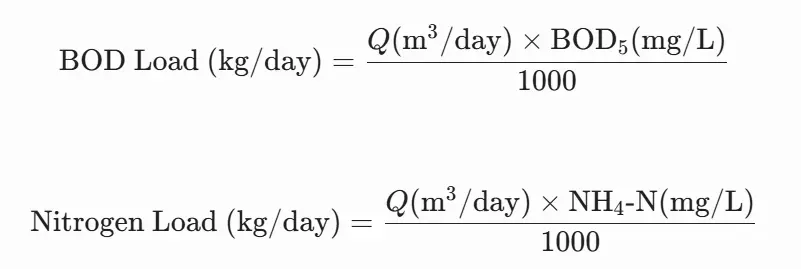
Microorganisms consume oxygen to decompose organic matter (BOD) and convert ammonia to nitrate (NH4-N). The total daily mass loading is calculated as:
Step 2: Determine Actual Oxygen Requirement (AOR)
Engineering empirical standards define baseline biological consumption ratios:
· Organic removal: Requires approx. 1.1 to 1.5 kg O2 per kg BOD5 destroyed.
· Nitrification: Requires 4.57 kg O2 per kg NH4-N oxidized.
AOR (kg O2/day) = (1.2 ×BOD Load) + (4.57 × Nitrogen Load)
Step 3: Convert AOR to Standard Oxygen Transfer Rate (SOTR)
Manufacturer performance rating tables reflect clean water testing at 20°C and standard sea-level atmospheric pressure. Real wastewater contains dissolved solids, surfactants, and operates at varying temperatures, reducing oxygen transfer efficiency.
To convert AOR (actual conditions) to SOTR (standard factory rating), apply environmental correction factors:

Where:
· α(Alpha Factor): Ratio of oxygen transfer in process water vs. clean water (typically 0.65-- 0.85 for jet and surface aeration).
·β(Beta Factor): Salinity and dissolved solids factor (0.95 -- 0.98).
· θ: Temperature correction factor (1.024).
Once you obtain your hourly SOTR (kg O₂/hr) requirement, you can match this figure against manufacturer capacity charts.
3. Balancing Oxygen Demand with Minimum Tank Mixing Power
A common mistake in plant design is sizing the aerator purely for oxygen mass delivery while ignoring mixing dynamics.
To maintain mixed liquor suspended solids (MLSS) in full suspension and prevent sludge accumulation on the tank floor, aeration hardware must supply adequate mechanical energy per unit volume:
· Standard Aerated Basins: Requires 15 to 25 Watts/m³ of basin volume.
· High-Solids Industrial Tanks: Requires 25 to 40 Watts/m³ of basin volume.
If your calculated oxygen requirement yields an equipment size that provides insufficient power for mixing, you must increase the equipment size or combine aeration with dedicated Submerged Mixers.
4. Selecting the Aeration Equipment Type
Different tank designs and effluent profiles demand specific equipment configurations:
· Submersible Jet & Ejector Aerators: Excellent for deep basins, high-salinity industrial effluent, and equalization tanks. They provide powerful localized horizontal current mixing, resist clogging, and eliminate aerosol/splash odor problems.
· Surface Mechanical Aerators: Highly effective in shallow lagoons, large oxidation ditches, and emergency retention basins where high volume surface contact and bulk liquid turnover are needed.
· Diffused Air Bubbler Systems: Best suited for shallow-to-medium deep municipal rectangular tanks requiring quiet operation and flexible biological zoning (anoxic/aerobic switching).
Partner with LJ Pumps for Engineering & Equipment Selection
Sizing wastewater aeration systems accurately requires balancing fluid dynamics, biological kinetic rates, and mechanical reliability.
At LJ Pumps, we manufacture and supply industrial-grade submerged jet aerators, centrifugal wastewater pumps, and mixing equipment built for demanding municipal and industrial environments.
Need assistance sizing your plant's aeration hardware?
Visit https://www.lanjiangequip.com/ or contact our technical sales team with your flow rate, influent $\text{BOD}$, and basin dimensions for a custom sizing proposal and technical drawing analysis.